Restoring the historic shanty
In about 1926, a shanty (simple hut) was built on Bense island to provide shelter for the farmhands who occasionally visited the island. Bense was used as a place to winter horses, the “vehicles” essential to farm work in those days. The horses swam about 1km over to the island from a beach on the nearby West Falkland mainland, led by men in a row boat. Once on Bense, the horses were left alone for the winter to graze and fatten up, and in the spring would be rounded up and swum back to the mainland ready to work for the next summer season.
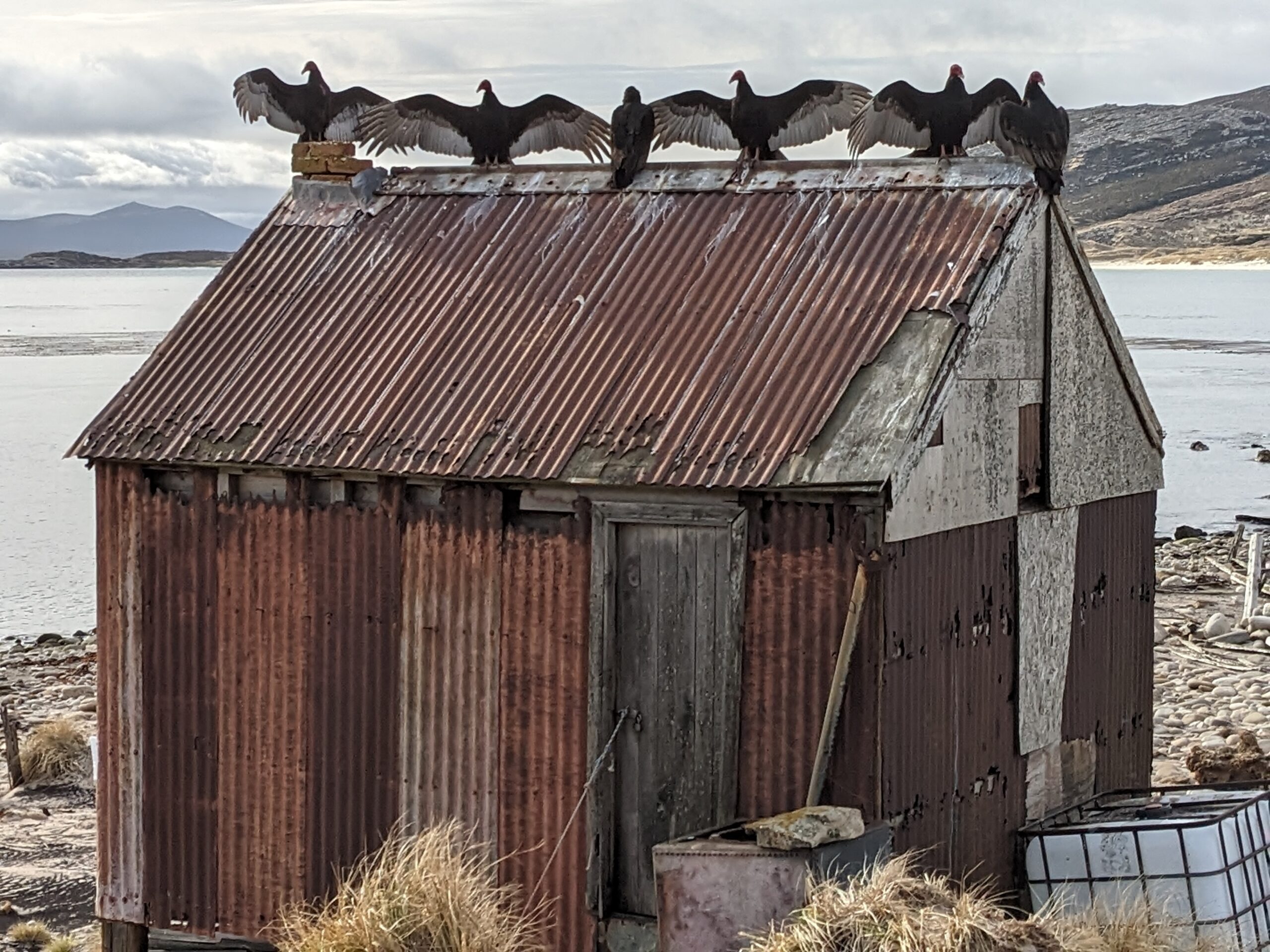
In the heyday of farming, shanties were found on many remote islands in the Falklands but in recent decades most have fallen into disrepair as they are used less and less. The shanty on Bense was a perfect example of this: when SAFER first visited the island in 1995, the window was gone and the door was open. Turkey vultures were nesting/roosting in the bunks inside and at least one pair of Falklands thrush were also nesting in there. This avian occupation, coupled with the harsh subantarctic weather, left this small building in poor condition and it was not habitable. After patching up the window and extensively cleaning the inside, the shanty became a very useful storage space but it was clear more extensive work would eventually be needed.
In October 2025, after about 20 years of further deterioration and ad hoc repairs to the shanty, we embarked on a restoration project to fix it properly. Making the building stable and weather-tight was the priority, but we also felt the shanty was an important part of the cultural heritage of the Falklands and we were keen to preserve it and the history it represents. Of particular importance is the graffiti inside, where farm workers have used the walls like a visitor’s book, recording their names, dates, and some of what they did on the island.
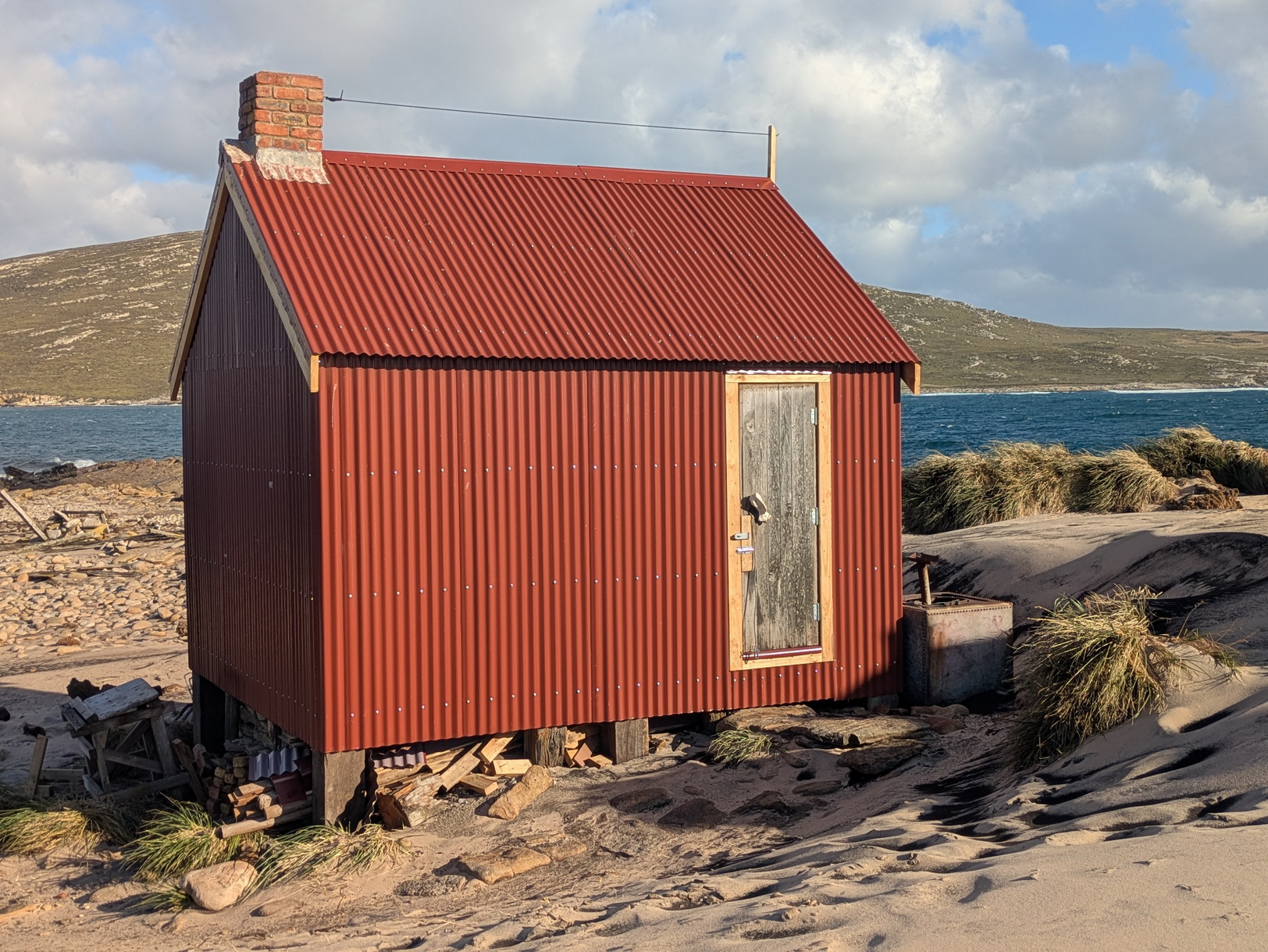
After a month of intensive work, the shanty now sits on new, stronger piles, and has been clad in a fresh skin of corrugated iron. Underneath that skin is now a sheath of plywood to add structural strength and provide another layer of weather protection for the interior. The inside of the shanty has been left “as is” and the writings of previous visitors can be found scattered around the walls. The earliest dated writing reads “E.B. Johnson Oct 16, 1926”.
Skilled carpenters were the key to the successful restoration: Alastair Fastier has for decades been involved in restoring historic huts in Antarctica, including those used by Robert Scott and Ernest Shackleton on their South Pole expeditions. Jim Davis also has a long career of construction in Antarctica and other challenging environments, and is the inventor of the Rac-Tent, an innovative polar shelter system. Both men understood the importance of working in sympathy with the original building, fixing it without changing the look too much from how its original builders intended. Old photos generously shared with SAFER by Judy Summers, Sam Miller and Hay Miller, and the Jane Cameron Archives, gave a glimpse of how the shanty looked in 1928 and 1932. These provided a template for what was needed, such as reconstructing the chimney and adding a wire along the ridge line to discourage perching caracaras and vultures. And although modern tools made the job easier, the team tried to do things as the original builders would have, like wrapping the roofing iron over the edge of the roof ends, rather than installing modern corner flashing. Also, the colour of the new cladding was carefully chosen to be as similar as possible to the original. The result is a sturdy building that has preserved some of the human history the Falkland Islands.